Research

Research Overview

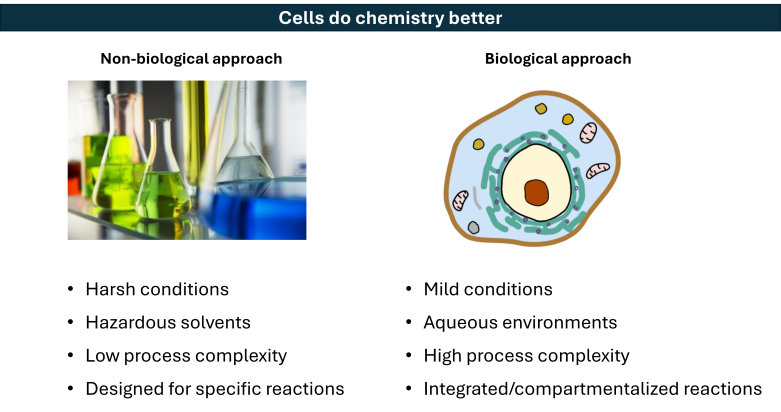
Modern chemistry has a central role in our technological society. But the classical methods we rely on to synthesize complex molecules are often wasteful and typically involve components that are harmful to the environment.


In contrast, biological cells have already solved the problem of making complex molecules efficiently. They function as chemical “nanofactories,” operating under biocompatible conditions and aligning with the principles of sustainable chemistry. 


Figure 1. Learning from nature.

Beyond that, cells can work together to form functional tissues and dynamic structures with capabilities far beyond what we can currently engineer in the lab.


Our research takes inspiration from nature to design synthetic, dynamic soft materials that replicate key cellular physical and chemical features, including:


(1) The efficient synthesis and processing of complex molecules in aqueous media under mild, environmentally friendly conditions.


(2) Modular responsive materials that can sense their environment, communicate, and adapt their chemistry, rheology, and structural organization in response to external cues.


(3) Multi-compartmental structures with a cell-like, compartment-in-compartment architecture that enables spatial and temporal control of chemical and physical processes within nano- to micrometer-scale assemblies.


Our work also seeks to:


(4) Elucidate the molecular mechanisms that drive the assembly and dynamic behavior of these bio-inspired systems, with an emphasis on condensate and fiber formation in aqueous media.


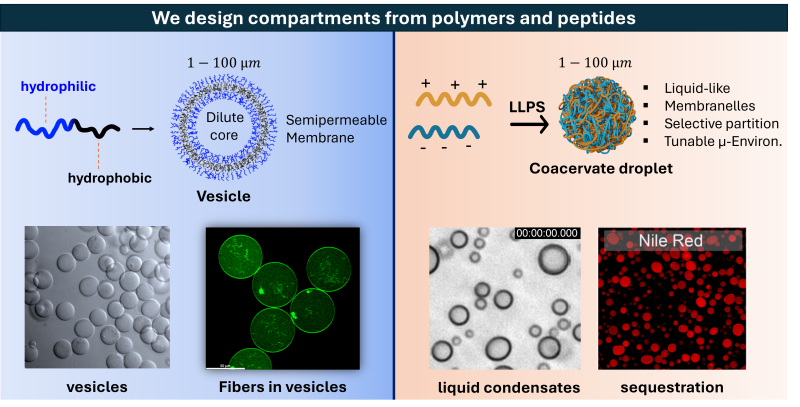
Our approach focuses on designing supramolecular chemical systems that use synthetic vesicles and condensates (coacervates) as structural building blocks and dynamic soft scaffolds to mimic cellular compartments (Figure 2). 

Figure 2. Biomimetic compartments of interest in our group include polymer vesicles and condensates (coacervates).

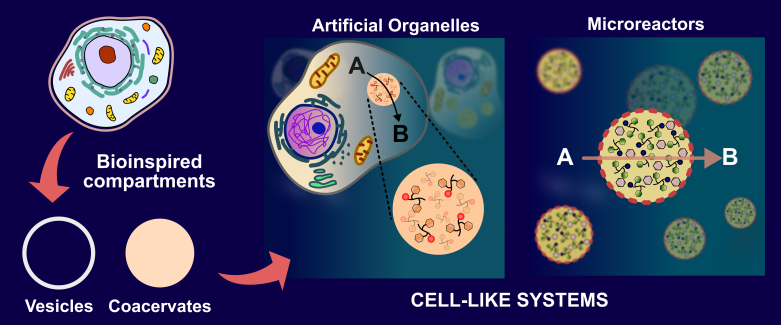
These systems not only provide a platform for studying the properties of biomimetic compartments but also serve as building blocks for engineering life-like systems, such as artificial organelles and microreactors (Figure 3).

Figure 3. Biomimetic compartments serve as building blocks for engineering life-like systems.

We are pursuing several application areas, including:

  • Microreactors for chemoenzymatic catalysis
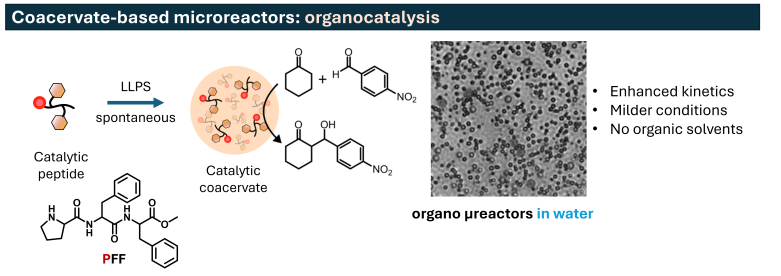
  • Catalytic condensates for organocatalysis
  • Controlled phase separation and fiber formation (liquid-to-solid transitions)
  • Stabilization of biomolecules, catalysts, and supramolecular assemblies
  • Design of minimal coacervate systems

Selected examples:


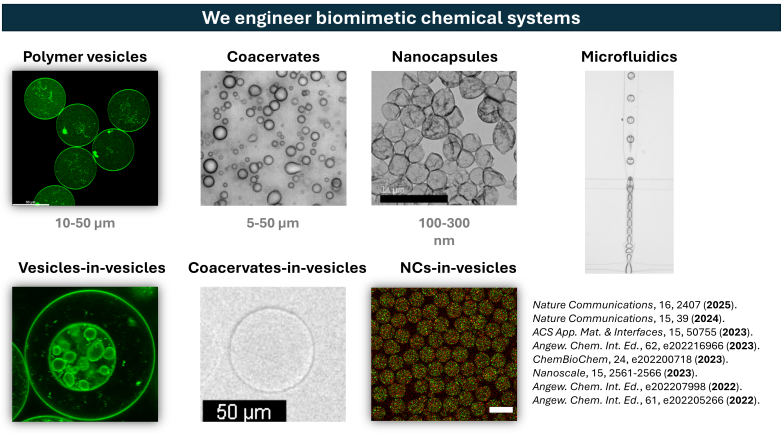
Our Lab has developed new types of biomimetic compartments that respond to stimuli such as temperature, pH, and light, greatly enhancing control, functionality, and stability in aqueous environments (Figure 4).1-3 These dynamic systems enable selective molecular partitioning, chemical communication, and the creation of finely tuned nano- and microscale environments, capabilities not accessible through classical chemical methods

Figure 4. Representative examples of biomimetic compartments and multicompartment systems developed by our group (2022-2025).

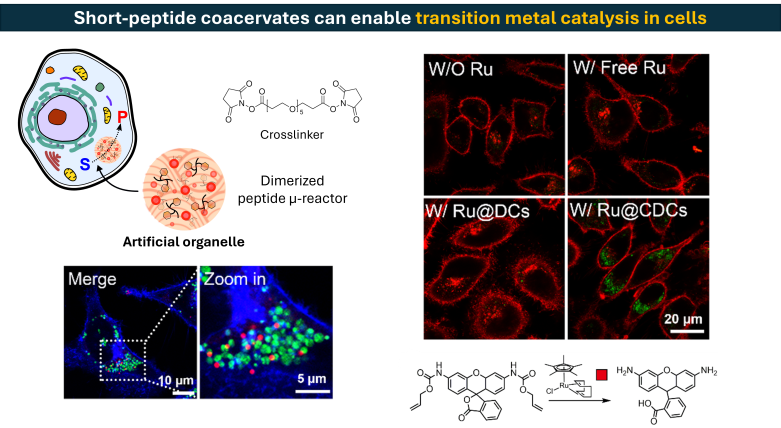
Our research has shown that these robust, responsive compartments can support complex chemical synthesis in water, eliminating the need for toxic organic solvents.2 More intriguingly, we have demonstrated that our engineered nanoreactors can be internalized by living cells and remain functional inside them, paving the way to hybrid synthetic-biological systems and therapeutic applications where externally designed nanoreactors can modulate cellular behavior from within (Figure 5).2

Figure 5. A peptide-based coacervate carrying transition-metal catalysts functions as an artificial organelle in living cells while preserving viability.

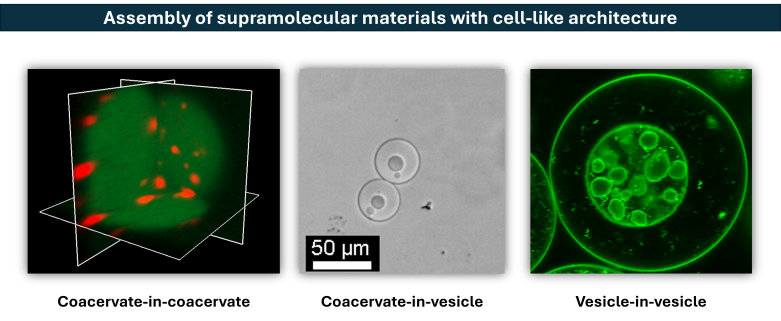
Beyond designing functional macromolecules and peptides, we are also developing techniques to assemble cell-like structures with tunable architecture (Figure 6).4

Figure 6. Combining biomimetic compartments yields multicompartmentalized soft materials with cell-like architecture

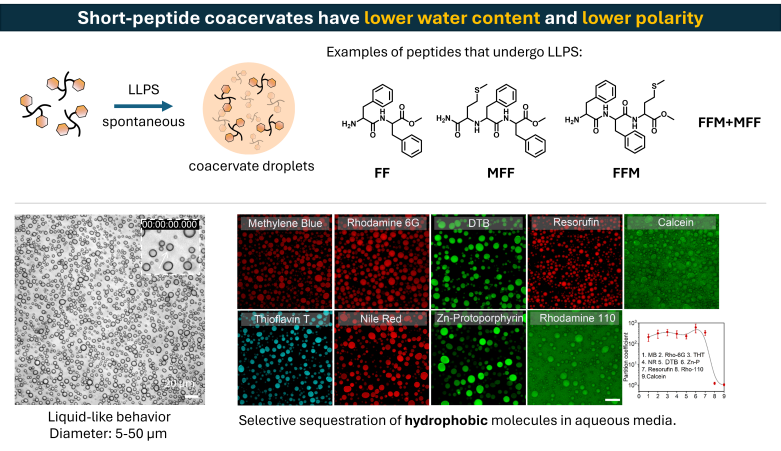
We have pioneered coacervates derived from “minimal” chemical structures, enabling direct correlations between molecular structure and material properties. These systems are based on short peptides, which allow for straightforward data analysis using well-established chemical and structural characterization techniques, as well as more affordable and reliable computational modeling (Figure 7). Through this integrated approach – combining molecular design, experimental characterization, and computer simulation – our research is establishing a new paradigm for understanding coacervate formation and their unique dynamic behavior.

Figure 7. Peptide-based coacervates developed by our group exhibit low polarity and reduced water content, enabling functional soft materials and cell-like catalysts.

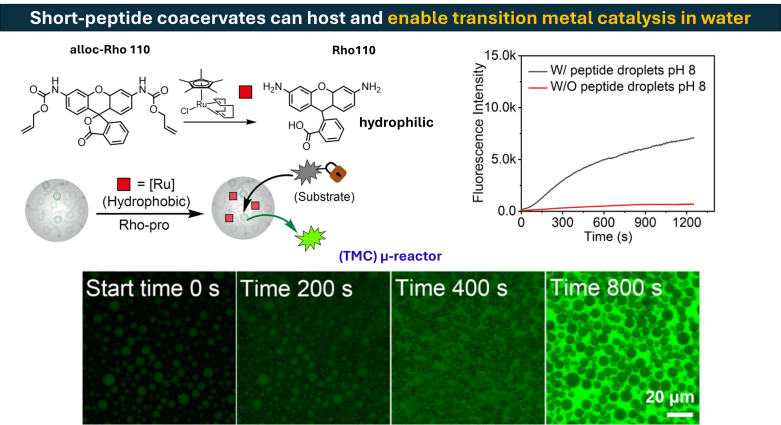
An interesting and powerful application of short-peptide coacervates introduced by our group is the design of new coacervate-based catalytic systems.2,3 Selective encapsulation of catalysts within the hydrophobic microenvironment of peptide coacervates enables chemical reactions in water to proceed faster and can even allow the activity of catalysts that are otherwise incompatible with aqueous media. For example, we demonstrated that a transition-metal catalyst can be active in water when incorporated into peptide coacervate droplets (Figure 8). 

Figure 8. A transition-metal catalyst encapsulated in peptide coacervate droplets enables reactions in water.

Another example of peptide coacervates in catalysis introduced by our group uses a proline-based peptide that forms self-catalytic coacervates for applications in organocatalysis (Figure 9).5 This work demonstrates that both the active site and the protective microenvironment can be encoded within a single simple peptide, reminiscent of how enzymes self-organize into catalytic structures based on sequence information.

Figure 9. A self-catalytic peptide coacervate for organocatalysis in water

In summary, our group designs and builds synthetic, life-like compartments with precise control from the molecular level to functional materials. This integrated approach allows us to address key challenges in creating artificial cell-like systems. By bridging chemistry and biology, we develop new strategies for efficient catalysis, engineer responsive soft materials that sense and adapt to their environment, and create models of cellular organization to explore biological compartmentalization and expand the functionality of synthetic materials. Ultimately, we aim to advance the development of artificial cells, bio-inspired catalytic systems, and responsive hierarchical materials for transformative applications in chemistry and biotechnology.

Selected references:

1. S. Cao, P. Zhou, G. Shen, T. Ivanov, X. Yan, K. Landfester, L. Caire da Silva*, “Binary Peptide Coacervates as an Active Model for Biomolecular Condensates”,  Nature Communications, 16, 2407 (2025). [link]

.

2. S. Cao, P. Zhou, G. Shen, T. Ivanov, X. Yan, K. Landfester, L. Caire da Silva*, “Dipeptide Coacervates as Artificial Membraneless Organelles for Bioorthogonal Catalysis”,  Nature Communications, 15, 39 (2024). [link]

.

3.  H. Bremm Madalosso, S. Cao, T. Ivanov, M. de Souza Melchiors, K. Koynov, C. Guindani, P. Henrique Hermes de Araújo, C. Sayer, K. Landfester, L. Caire da Silva*, “Peptide-Induced Division of Polymersomes for Biomimetic Compartmentalization”, Angewandte Chemie International Edition, e202413089 (2024). [link]

.

4. T. Ivanov, S. Cao, N. Bohra, M. de Souza Melchiors, L. Caire da Silva*, and K. Landfester*. “Polymeric Microreactors with pH-Controlled Spatial Localization of Cascade Reactions”, ACS Applied Materials & Interfaces, 15, 50755-50764 (2023). [link]

.

5. Z. Dai, M. Meyn, and L. Caire da Silva*. “Organocatalytic Peptide Coacervates as Microreactors for Aqueous Aldol Reactions”, ChemRXiv (2025). doi:10.26434/chemrxiv-2025-zh29q [link]